
Why This Roundup Matters for Indian Sellers
Most AI product photography reviews are written from US or European studios with budgets, lighting kits, and shoot volumes that don't match Indian D2C reality. The cheapest tier of Photoroom, the free tier of Claid.ai, and the Photoshop Generative Fill bundled with Creative Cloud all behave differently when your actual shoot is a 5-SKU drop-shipper catalog in a 200-square-foot studio.
I run a commercial product studio in Dehradun, Uttarakhand. We shoot for D2C brands selling on Amazon India, Flipkart, Myntra, Shopify, and direct-to-consumer websites. Over the last 18 months, my team has tested every major AI product photography tool on real client work. This is the ranking — what to use, what to skip, and where AI actually saves money versus where it quietly costs you.
If you sell on Indian marketplaces, build a D2C brand, or shoot catalog for one, this guide is built for your actual workflow. Not the demo reel version.
What Counts as "AI Product Photography" in 2026
The category has exploded. Let me define it before ranking, because the tools do very different things under the same label.
AI Background Removal
Strips the background, leaves a clean cutout. Older tools fail on hair, fur, transparent glass. Newer tools regenerate a soft contact shadow so the product looks grounded.
Photoroom, Adobe Photoshop (Select Subject), remove.bg
AI Background Replacement
Removes the background AND generates a new scene — a lifestyle kitchen, a marble counter, a moody studio set. This is where hallucination risk starts.
Photoroom AI Backgrounds, Claid.ai, Photta, Adobe Firefly
AI Catalog Generation
You upload one product photo and the tool generates dozens of styled variants — different angles, colors, models, props, marketplaces. The biggest time-saver if it works.
Claid.ai, Photta, Flair AI
AI Upscaling & Sharpening
Boosts resolution, denoises, and recovers detail from soft photos. Useful for older catalog images and small-listing thumbnails.
Topaz Gigapixel, Magnific AI, Photoshop Super Resolution
AI Object Cleanup
Removes dust, scratches, fingerprints, props you don't want. Critical for jewelry, watches, cosmetics, and any reflective surface.
Photoshop Generative Fill, Retouch4me, Evoto
AI Model Try-On & Apparel
Generates realistic human models wearing your garment. Huge for D2C fashion and Myntra listings — but trust issues with skin, body shape, and fabric behavior.
Photta, Vue.ai, Lalaland.ai
Each category earns its place in a working studio for a different reason. Ranking them as if they compete is the mistake most roundups make.
The 8 Tools I Actually Use at My Dehradun Studio
These are the tools that earned a place on the studio machine after 18 months of real client work. Anything that didn't make this list either didn't ship on Indian market requirements, was slower than manual work, or had a hallucination rate we couldn't ship.
Adobe Photoshop + Firefly
Best for: Studio-grade brand work, complex composites, full manual control
India pricing: ₹1,695/month (Creative Cloud Photography plan with Photoshop + Lightroom + Firefly credits)
Photoshop's AI Select Subject is the most accurate cutout tool we have tested on hard surfaces — leather, glass, reflective metals. Firefly's Generative Fill extends backgrounds and adds realistic shadows. We use it daily for hero brand imagery where a 2-3% texture hallucination is unacceptable. The downside: speed. A skilled retoucher using Photoshop is still 3-5x slower than Photoroom on a pure packshot.
Best for brand campaigns, hero imagery, anything that lives on a homepage or print. Skip for high-volume marketplace work.
Photoroom
Best for: Marketplace packshots at scale, mobile-first sellers
India pricing: Free tier (limited); Pro at ~₹800/month via App Store; Teams from $9.99/month
Fastest path from phone photo to marketplace-ready packshot. Background removal with auto-regenerated contact shadow is excellent. Batch processing for 50-100 SKUs is genuinely useful — we run client catalog rebuilds in hours instead of days. The Pro tier adds AI Backgrounds (lifestyle scenes) and the AI Shadows module. The catch: lifestyle backgrounds can look generic, and the AI model has a recognizable 'Photoroom look' that experienced buyers spot. For pure white-background listings (Amazon, Flipkart, Myntra), it's the default choice.
Best for marketplace catalog, dropshipping sellers, social commerce.
Claid.ai
Best for: AI catalog generation, automated lifestyle variants
India pricing: From $9/month for the Studio plan; agency tier from $49/month
Claid is the most ambitious end-to-end AI product photography platform we tested. Upload one studio shot of a coffee mug and it generates 12 lifestyle variants — kitchens, offices, cafes, gift boxes, model hands. For D2C brands that need to ship 50 lifestyle variations per SKU per quarter, this replaces a fashion-stylist day. The output quality is high, but it can over-stylize. We use it as a fast first pass and then re-shoot the 3-5 hero images manually for brand work.
Best for D2C brands with lifestyle-heavy catalogs and tight quarterly drops.
Topaz Gigapixel AI
Best for: Upscaling soft or low-res catalog images
India pricing: $99 one-time (Topaz Photo AI bundle)
Topaz is not a background tool — it's the best AI upscaler we have tested for product photography. If you have older catalog images shot on older cameras, or you're upsizing for a print campaign, Topaz recovers detail that Photoshop's Super Resolution cannot. It's also the safest AI denoiser for high-ISO product shots.
Best as a supplemental tool, not a primary AI stack.
Photta
Best for: Full-stack AI catalog generation including apparel
India pricing: Credit-based: 3-6 credits per image depending on style
Photta is a newer entrant but worth watching. It handles product photography, apparel on AI models, ghost mannequin, jewelry, and eyewear studios in one tool. The model-rendering for fashion is faster than Vue.ai. For sellers testing the AI-model-only approach (no human model at all), Photta currently ships the most realistic fabric behavior.
Best for AI-model-first D2C fashion catalogs.
Adobe Lightroom (AI Masking)
Best for: Catalog color correction, batch tonal work
India pricing: ₹1,034/month (Lightroom plan)
Lightroom's AI Masking is underrated for catalog work. AI Sky, AI Subject, and AI Denoise let a single retoucher grade 500 SKUs in a day. We use it for the catalog consistency pass — making sure 800 product images have the same white balance, exposure curve, and shadow density before they ship to a marketplace.
Best for batch consistency on large catalogs.
Magnific AI
Best for: Detail recovery for jewelry, watches, fabric close-ups
India pricing: From $39/month; Pro $99/month
Magnific adds hallucinated detail rather than just upscaling. Useful for jewelry close-ups where you want the macro shot to feel even more macro than your lens allowed. Risky for product photography where the buyer expects accurate representation — buyers who zoom into a Magnific-sharpened watch dial and receive a softer real watch will return it.
Use with care — only for editorial, not for buy-decision images.
Evoto AI
Best for: Tethered culling + bulk portrait retouch
India pricing: From $7.99/month per photographer
Evoto is the bridge between catalog work and portrait work. It batches portrait retouches, manages tethered culling, and ships a color-matching AI for multi-camera shoots. For us, it sits in the wedding and event photography workflow more than the product catalog workflow, but D2C brands doing on-model lifestyle shoots use it heavily.
Best if you also shoot on-model lifestyle.
The Trust Problem With AI Product Photography
This is the part nobody puts in the marketing copy, and it is the most important part of the decision.
AI tools hallucinate texture. They will invent a leather grain that wasn't there, add reflection to glass that wasn't that bright, smooth fabric that had real weave. For editorial mood boards and lifestyle mood imagery, this is fine. For buy-decision product imagery — the photo the customer uses to decide whether to add to cart — hallucination kills conversion and triggers returns.
In our Dehradun studio, the rule is simple:
Hero Imagery = Real Studio Always
The 3-5 images on your product detail page that drive the buy decision. No AI compositing. Real lighting, real texture. Buyer expectation is anchored here.
Marketplace Packshots = AI-Allowed
For Amazon, Flipkart, Meesho listings — pure white backgrounds, multiple angles — AI background removal and shadow regeneration is now indistinguishable from studio work. Speed wins here.
Lifestyle & Social = Hybrid
Real product on real surface (wood, marble, fabric) shot in-studio, then AI-extended into broader scenes. Trust the product, generate the scene.
AI Models = Risk Decision
AI models work for the brand layer (Instagram, ads, lookbooks). They fail when the customer zooms in to check fabric drape, stitching, fit. For buy-decision product imagery, real models still win.
If you remember nothing else from this guide: AI is a production accelerator, not a truth generator. Use it where the buyer doesn't need ground truth.
How an Indian D2C Brand Should Stack These Tools
Most Indian D2C brands at the ₹1-10 Cr revenue stage shoot catalog themselves or use a local studio for one batch per quarter. Here is the AI stack I recommend for that scale:
Tier 1: ₹0-₹2,000/month
Photoroom Pro + Lightroom + Photoshop (if you already have CC)
Solo sellers, dropshippers, side hustles. Pure marketplace catalog.
100+ SKUs catalog ready per week from phone photos.
Tier 2: ₹2,000-₹8,000/month
Photoshop + Firefly + Claid.ai Studio + Topaz
Growing D2C brands, 50-200 SKUs, lifestyle imagery required.
Brand-consistent catalog with hybrid real + AI lifestyle shots.
Tier 3: ₹8,000+/month + Studio
Full Adobe stack + Claid.ai Agency + Photta + studio days
Established brands, ₹10 Cr+ revenue, marketplace + D2C + retail.
Hybrid studio + AI workflow we run for clients at this level.
Tier 2 is where most Indian D2C brands plateau — they outgrow smartphone-only catalog work but haven't yet hired an in-house studio team. That is the bracket where a hybrid real-studio + AI workflow pays for itself within one quarter.
What I Would Skip in 2026
Three categories that look promising on paper and waste time in practice for catalog photography:
Pure-Prompt AI Image Generators (Midjourney, ChatGPT Images, DALL-E)
These are mood-board tools. They generate a beautiful image of a coffee mug — not YOUR coffee mug. For buy-decision product imagery, they hallucinate branding, materials, and proportions. Use them for campaign concepts, not for product listings.
AI Video Generation for Product Hero
Runway, Pika, and Sora are incredible for short social clips — but a 5-second AI-generated product hero cannot answer 'what does the product actually look like in my hand.' Trust breaks. Reserve AI video for brand storytelling, not buy-decision.
Fully Automated 'Drop in a Photo, Get a Catalog' SaaS
The pitch is seductive. The output is generic. The 'Photoroom look' or 'Claid look' reads as AI to anyone with a trained eye. For serious brands, the AI catalog approach produces work that looks like every other AI catalog. Hire a studio. The cost difference pays for itself in conversion.
The Dehradun Studio Workflow (Real Numbers)
For a typical D2C catalog job at our Dehradun studio — 60 SKUs, 3 angles each, marketplace + Shopify + lifestyle variants — here is how the AI tools split the work:
Total: 3.5 working days instead of 8. The studio bill to the client comes down, the turnaround halves, and the marketplace listings still ship with real texture in the hero images.
Final Verdict
AI product photography in 2026 is real, it works, and Indian D2C brands that ignore it will fall behind on speed and catalog volume. But it is not a replacement for a studio — it is a force multiplier for one.
If you sell on Amazon, Flipkart, Myntra, or Meesho: start with Photoroom Pro today. It pays for itself in the first 50 SKU batch.
If you run a D2C brand that needs brand-consistent lifestyle imagery: invest in Adobe Photoshop + Firefly and Claid.ai. Hire a studio for the hero shots. Use AI for everything around them.
If you shoot product for a living: add Topaz and Lightroom AI masking to your catalog workflow. You will bill the same hours but deliver twice the catalog volume to your clients.
Frequently Asked Questions
What is the best AI tool for product photography in 2026?
For marketplace catalog work (Amazon, Flipkart, Myntra), Photoroom remains the fastest path to clean white-background images at scale. For brand and lifestyle composites with more control, Adobe Photoshop + Firefly is the safer studio choice. Claid.ai and Photta handle full AI catalog generation for sellers who can live with less manual control.
Is AI product photography good enough to replace a studio shoot?
For Amazon/Flipkart/Meesho packshots on plain backgrounds, the current generation of AI tools is good enough for many sellers to skip a physical shoot. For hero brand imagery, editorial work, and any product where texture and material truth matter (leather, glass, cosmetics, jewelry), a real studio shoot still wins on trust and conversion.
How much does AI product photography cost in India?
AI-only workflows range from free tiers (Photoroom, Adobe Firefly) up to ₹3,000-₹4,000 per month for power users. In our Dehradun studio, the hybrid model — physical shoot for hero images + AI for variants and lifestyle — is the most cost-effective for D2C brands that need both speed and trust.
Can AI remove backgrounds for e-commerce without losing shadows?
Modern AI tools (Photoroom Pro, Photoshop 2026, Claid.ai) regenerate contact shadows when you remove the background. The result looks grounded instead of the floating-cutout look from older tools. For pure-white marketplace listings, AI shadows are now indistinguishable from studio work.
Which AI tool is best for Indian e-commerce marketplaces?
For Amazon India, Flipkart, Myntra, and Meesho, Photoroom is the most widely adopted because it produces marketplace- compliant crops and pure-white backgrounds at scale. For larger brands that need lifestyle and brand consistency, Adobe Photoshop + Firefly or Claid.ai are the studio-grade choices.
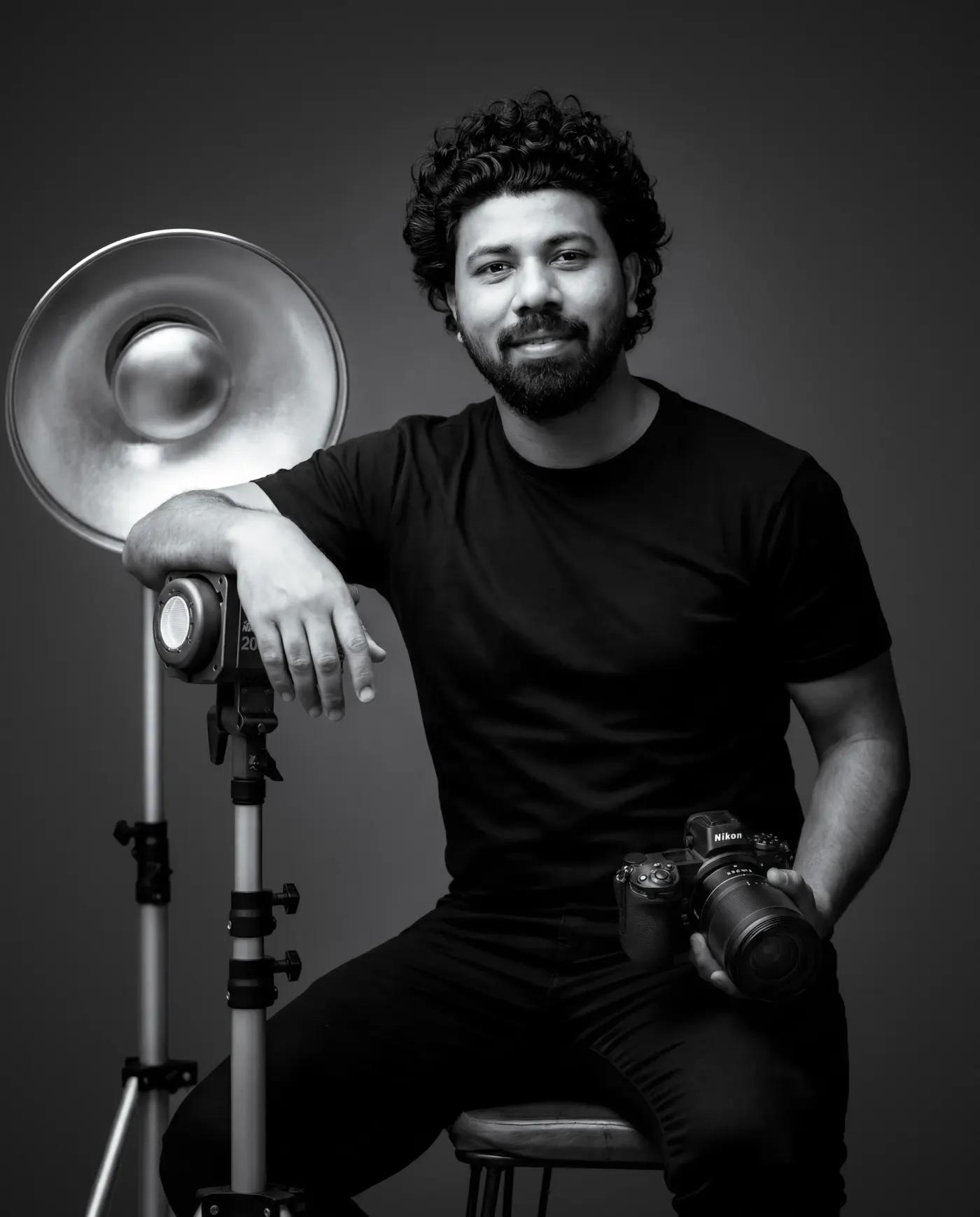
About the author
Rahul Chanda
Commercial product photographer based in Dehradun, India. 6+ years shooting product, food & beverage, and advertising campaigns with in-house retouching. Serving brands across Uttarakhand and pan-India.
View full profile →Need a Studio for Your Hero Product Shots?
AI handles variants, marketplace crops, and lifestyle extensions. Your hero images still need a real studio, real lighting, and a photographer who understands how Indian buyers read product imagery. We shoot D2C catalog for brands across India from our Dehradun studio.
Book Product Photography